
Seeing Flashes of Light or Floating Spots? When Should You Worry?
Have you ever noticed tiny black spots, thread-like shapes or cobweb-like shadows moving across your vision? Or suddenly seen brief flashes of light, even when there is no light source around you?
These visual disturbances are commonly described as eye floaters and flashes. They can sometimes occur because of natural changes inside the eye. However, a sudden increase in floaters or new flashes of light can also be an early warning sign of a retinal tear or retinal detachment — conditions that require urgent eye assessment.
The important thing is knowing the difference between floaters that have been present for a long time and sudden changes that should never be ignored.
This article explains what eye floaters and flashes are, how posterior vitreous detachment (PVD) occurs, the warning signs of retinal detachment, and when to consult a retina specialist in Kolhapur.
Quick answer: When should you worry about flashes and floaters?
A few stable floaters may be related to age-related changes inside the eye. However, a sudden appearance of new floaters, repeated flashes of light, a dark curtain or shadow, or sudden blurred or reduced vision needs urgent assessment by an eye specialist. These symptoms may indicate a retinal tear or retinal detachment.
What Are Eye Floaters?
Eye floaters are small spots, dots, lines or shapes that appear to move across your field of vision. They may look like:
- Tiny black or grey dots.
- Thin threads or squiggly lines.
- Cobweb-like patterns.
- Small circles or ring-shaped shadows.
- Dust-like particles floating in front of your eyes.
You may notice them more clearly when looking at a plain, bright background, such as a white wall, a computer screen or a clear blue sky.
Although floaters may appear to be in front of your eyes, they usually originate inside the eye.
The inside of the eye is filled with a clear, jelly-like substance called the vitreous. As this gel changes with age, tiny fibres or clumps can form within it. These structures cast shadows on the retina, and the shadows are perceived as floaters.
A few floaters that have been present for a long time and are not changing may not indicate a serious problem. However, new or suddenly increasing floaters should always be assessed promptly.
What Causes Flashes of Light in the Eyes?
Flashes of light are brief streaks, sparks or lightning-like patterns that appear in your vision even when there is no external source of light.
Some people describe them as:
- Small lightning streaks at the side of their vision.
- Brief flashes when moving their eyes.
- Repeated flickering lights in their peripheral vision.
- A sudden spark-like sensation in one eye.
One common cause is traction on the retina.
As the vitreous gel changes and moves inside the eye, it may pull on the retina. The retina can interpret this mechanical stimulation as flashes of light.
Flashes can also occur with certain migraine-related visual disturbances. However, it is important not to assume that new flashes are caused by migraine without an appropriate assessment, particularly if they occur with new floaters or changes in vision.
What Is Posterior Vitreous Detachment (PVD)?
Posterior Vitreous Detachment, commonly called PVD, is a condition in which the vitreous gel separates from the retina at the back of the eye.
The vitreous is normally attached to the retina through tiny fibres. With ageing, this gel gradually becomes more liquid and shrinks. Eventually, it may pull away from the retinal surface.
This separation is known as posterior vitreous detachment.
PVD is relatively common as people get older, particularly after the age of 50. It can cause:
- New floaters.
- Flashes of light in the peripheral vision.
- Cobweb-like shadows.
- A sudden increase in visible spots.
In many people, PVD occurs without causing retinal damage. The floaters may gradually become less noticeable as the brain adapts to them.
However, during separation, the vitreous may pull strongly on certain areas of the retina. This can sometimes cause a retinal tear.
That is why a person experiencing new flashes or floaters should not assume that they are harmless age-related changes.
Can Posterior Vitreous Detachment Cause a Retinal Tear?
Yes. Although most cases of PVD do not lead to a retinal tear, the pulling force created during separation can sometimes damage the retina.
Think of the retina as a thin, light-sensitive layer lining the back of the eye. If the vitreous pulls strongly on a weak area, it may create a small break or tear.
Fluid can then pass through this opening and collect underneath the retina.
This may cause the retina to separate from its normal position, resulting in a condition called retinal detachment.
A retinal tear does not always mean that retinal detachment has already occurred. However, it needs prompt evaluation because timely treatment of a tear may help prevent progression to detachment.
What Is Retinal Detachment?
Retinal detachment occurs when the retina separates from the tissue supporting it at the back of the eye.
The retina plays an essential role in vision. It receives light and sends visual signals to the brain. When it becomes detached, its normal function is affected.
Retinal detachment is a serious eye condition that requires urgent medical attention. Without timely treatment, it can lead to permanent vision loss.
What Are the Warning Signs of Retinal Detachment?
Watch for these important symptoms:
1. Sudden Increase in Floaters
You may suddenly notice many new black spots, dots or cobweb-like shapes in your vision. Some people describe this as a shower of floaters.
2. Repeated Flashes of Light
You may experience sudden flashes or lightning-like streaks, especially towards the sides of your vision.
3. A Dark Shadow in Your Vision
A dark area may appear in your peripheral vision and gradually become more noticeable.
4. A Curtain-Like Effect
Some people describe it as a dark curtain, veil or shadow moving across part of their vision. This is a particularly important warning sign.
5. Sudden Blurred or Reduced Vision
Your vision may become unclear or noticeably reduced. The change may affect one part of your visual field or a larger area.
Important: Retinal detachment may not always cause pain. Do not wait for pain or complete vision loss before seeking help.
If you experience a sudden shower of floaters, new flashes, a curtain-like shadow or sudden reduction in vision, seek urgent eye care immediately. Do not wait for a routine appointment or for symptoms to disappear.
How Are Floaters, PVD and Retinal Detachment Different?
These conditions are related, but they are not the same.
| Condition | What happens inside the eye? | Possible symptoms |
| Eye floaters | Small clumps or fibres in the vitreous cast shadows on the retina | Spots, dots, threads or cobweb-like shapes |
| Posterior vitreous detachment | The vitreous gel separates from the retina | New floaters and flashes |
| Retinal tear | The retina develops a break, sometimes due to vitreous pulling | Sudden floaters, flashes or sometimes no obvious symptoms |
| Retinal detachment | Fluid passes through a retinal break and separates the retina from its supporting tissue | Flashes, floaters, shadow, curtain-like vision loss or blurred vision |
A person cannot reliably distinguish these conditions based on symptoms alone. A proper retinal examination is necessary.
Who Is at Higher Risk of Retinal Tears or Retinal Detachment?
People who have undergone certain eye surgeries may have an increased risk of retinal detachment. If you have a history of cataract eye surgery in Kolhapur, follow your ophthalmologist’s advice regarding retinal examinations.
Retinal detachment can happen to anyone, but certain factors may increase the risk.
1. High Myopia
People with high myopia, or severe short-sightedness, may have a higher risk of retinal problems because the shape and structure of the eye can make the retina more vulnerable.
2. Increasing Age
Age-related changes in the vitreous make posterior vitreous detachment more common as people get older.
3. Previous Cataract or Other Eye Surgery
People who have undergone certain eye surgeries may have an increased risk of retinal detachment.
4. Previous Retinal Tear or Detachment
If you have experienced a retinal tear or detachment in one eye, your other eye may also need careful monitoring.
5. Family History
A family history of retinal detachment can be an important risk factor.
6. Eye Injury
An injury or direct impact to the eye can sometimes damage the retina and increase the risk of a tear or detachment.
7. Certain Retinal Conditions
Some people have naturally weak areas in the peripheral retina, such as lattice degeneration. These areas may increase the risk of retinal tears.
Having one or more risk factors does not mean that retinal detachment will definitely occur. However, it makes appropriate eye examinations particularly important.
How Are Flashes and Floaters Diagnosed?
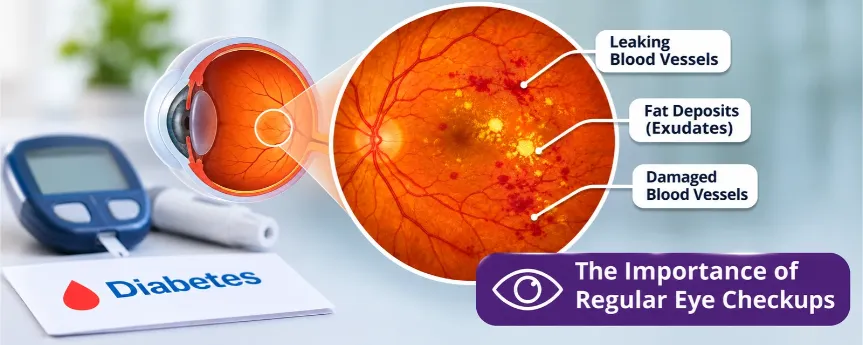
People with diabetes should follow their doctor’s advice and undergo appropriate retinal screening. Learn more about Diabetic Retinopathy and Eye Health.
A timely Eye Checkup in Kolhapur can help identify the cause of new floaters and flashes and determine whether further retinal evaluation is required.
If you experience new flashes or floaters, an eye specialist will assess the symptoms and examine the retina to identify the cause.
The most important investigation is generally a dilated retinal examination.
1. Dilated Eye Examination
Eye drops are used to widen the pupils so that the ophthalmologist can examine the retina and the back of the eye.
This helps the doctor look for:
- Retinal tears.
- Areas of retinal weakness.
- Signs of posterior vitreous detachment.
- Bleeding inside the eye.
- Retinal detachment.
A careful examination of the peripheral retina is important because some retinal tears occur away from the central area.
2. Fundus Examination
The doctor examines the retina using specialised instruments to identify abnormalities in its structure and appearance.
3. OCT Scan
Optical Coherence Tomography (OCT) provides detailed cross-sectional images of the retina. It may be recommended when the doctor needs to assess the central retina or investigate associated retinal changes.
OCT does not replace a complete peripheral retinal examination when a retinal tear or detachment is suspected.
4. Ultrasound Scan of the Eye
If bleeding or other problems prevent the doctor from seeing the retina clearly, an ocular ultrasound may be recommended to assess the inside of the eye.
Not every patient needs all these investigations. The tests depend on the symptoms and clinical examination findings.
What Is the Treatment for Eye Floaters?
Treatment depends on what is causing the floaters and how much they affect vision.
1. Observation and Follow-Up
If the floaters are related to uncomplicated age-related vitreous changes and the retina is healthy, treatment may not be necessary.
Many people gradually become less aware of floaters as the brain adapts to them.
The doctor may recommend follow-up examinations depending on the findings and symptoms.
2. Treatment of the Underlying Cause
If floaters are caused by bleeding, inflammation or another eye condition, treatment will focus on the underlying problem.
3. Vitrectomy Surgery
In selected cases, when floaters are severe, persistent and significantly interfere with daily activities, a procedure called vitrectomy may be considered.
During this surgery, the vitreous gel is removed and replaced with a suitable fluid.
However, vitrectomy is not routinely recommended for ordinary floaters because it is an invasive procedure and carries risks, including retinal tears or detachment, infection and cataract development.
The potential benefits and risks must be carefully discussed with the ophthalmologist.
There is no routine eye drop or home remedy that removes age-related vitreous floaters. Do not delay an examination by trying unproven treatments.
How Is a Retinal Tear or Retinal Detachment Treated?
Treatment depends on whether the retina has developed a tear or has already detached.
1. Laser Treatment for Retinal Tears
If a retinal tear is detected before significant detachment occurs, laser photocoagulation may be used to create a protective seal around the tear.
This helps prevent fluid from passing through the opening and causing retinal detachment.
In selected cases, cryotherapy (freezing treatment) may be used instead.
2. Retinal Detachment Surgery
If the retina has already detached, surgery may be required.
Depending on the type, location and extent of detachment, the surgeon may recommend:
- Vitrectomy: The vitreous gel is removed and the retina is repositioned.
- Scleral buckling: A flexible band is placed around the outside of the eye to support the retinal wall.
- Pneumatic retinopexy: A gas bubble is injected into the eye to help reposition the retina in selected cases.
The surgeon may also use laser or freezing treatment to seal retinal breaks.
The appropriate procedure depends on the individual retinal findings. Early assessment is important because delaying treatment can increase the risk of permanent vision loss.
Can Eye Floaters and Flashes Be Prevented?
Not all floaters or flashes can be prevented. Age-related changes in the vitreous are a natural part of ageing.
However, you can take steps to protect your eye health:
- Attend regular eye examinations: This is especially important if you have high myopia, a previous retinal tear or a history of eye surgery.
- Do not ignore sudden changes: New floaters or flashes should be assessed promptly.
- Protect your eyes from injury: Use suitable eye protection during activities that may cause eye injuries.
- Manage existing health conditions: Conditions such as diabetes should be monitored and managed with your treating doctor.
- Follow your eye specialist’s advice: If you have been diagnosed with a retinal condition, attend the recommended follow-up appointments.
Most importantly, do not wait for your vision to become severely affected before seeking an examination.
When Should You Consult a Retina Specialist?

If you are experiencing sudden changes in vision in Kolhapur, seek prompt assessment from an Eye Doctor in Kolhapur or retina specialist.
You should seek urgent eye assessment if you notice:
- Flashes of light for the first time.
- A sudden increase in the number of floaters.
- Flashes along with new floaters.
- A sudden cloud or shower of black spots.
- A dark shadow or curtain-like effect in your vision.
- Sudden blurred or reduced vision.
These symptoms may indicate a retinal tear or retinal detachment. Do not wait until the next day or for a routine appointment if you experience these warning signs.
If you are experiencing sudden changes in vision in Kolhapur, seek prompt assessment from an ophthalmologist or retina specialist.
An examination can help identify whether the symptoms are related to uncomplicated PVD, a retinal tear or another eye condition.
Frequently Asked Questions About Eye Floaters and Flashes
1. Are eye floaters dangerous?
A few floaters that have been present for a long time and are not increasing may be harmless. However, sudden new floaters or a rapid increase in their number can indicate a retinal tear or another eye problem. They should be assessed promptly.
2. Why do I suddenly see flashes of light in one eye?
Flashes may occur when the vitreous gel pulls on the retina, particularly during posterior vitreous detachment. They can also occur with migraine-related visual disturbances. New flashes, especially when accompanied by floaters or vision changes, need urgent retinal assessment.
3. Can posterior vitreous detachment cause blindness?
Most cases of posterior vitreous detachment do not cause vision loss. However, in some cases, the vitreous can pull strongly on the retina and cause a retinal tear. If the tear progresses to retinal detachment, it can lead to severe or permanent vision loss without timely treatment.
4. How do I know if floaters are a sign of retinal detachment?
A sudden increase in floaters, repeated flashes of light, a dark shadow, a curtain-like effect or sudden blurred vision may be warning signs. Symptoms alone cannot confirm retinal detachment. A dilated retinal examination is needed.
5. Can eye floaters disappear on their own?
Some floaters become less noticeable over time as the brain adapts to them. However, they may not disappear completely. New or suddenly increasing floaters should be examined before assuming they are harmless.
6. Can eye floaters be treated with eye drops?
There is no established routine eye drop treatment that removes ordinary age-related vitreous floaters. Treatment depends on the cause. Severe, persistent floaters may be considered for surgery in selected cases after discussing the risks and benefits.
7. Is retinal detachment an emergency?
Yes. Retinal detachment is a sight-threatening condition that needs urgent medical attention. Sudden flashes, a shower of new floaters, a curtain-like shadow or sudden vision reduction should be assessed immediately.
8. Which doctor should I consult for eye floaters in Kolhapur?
An ophthalmologist can examine the eye and identify the cause of floaters. If a retinal tear, retinal detachment or another retinal condition is suspected, assessment by a retina specialist is important.
About Drishti Deep Phaco & Eye Care Centre, Kolhapur
Drishti Deep Phaco & Eye Care Centre provides eye-care services in Kolhapur, with clinics at Bindu Chowk and Nagala Park.
The centre is associated with Dr. Mandar Patil (MS Ophthalmology), who has over 31 years of experience in eye care.
Sudden flashes, new floaters or a curtain-like shadow in your vision should never be ignored. A timely eye examination can help identify retinal problems and determine whether further treatment is required.
For information about eye examinations and available eye-care services, contact Drishti Deep Phaco & Eye Care Centre.
Clinic locations:
Bindu Chowk
633, Shivaji Road, Bindu Chowk, C Ward, Laxmipuri, Kolhapur, Maharashtra.
Nagala Park
249/31, E Ward, Nagala Park, Kolhapur, Maharashtra.
Contact: 9766710636
Website: www.drishtideepnetraseva.com
Medical note: This article is for general educational purposes and does not replace an eye examination. Sudden flashes, new floaters, a curtain-like shadow or sudden vision loss require urgent medical assessment.
